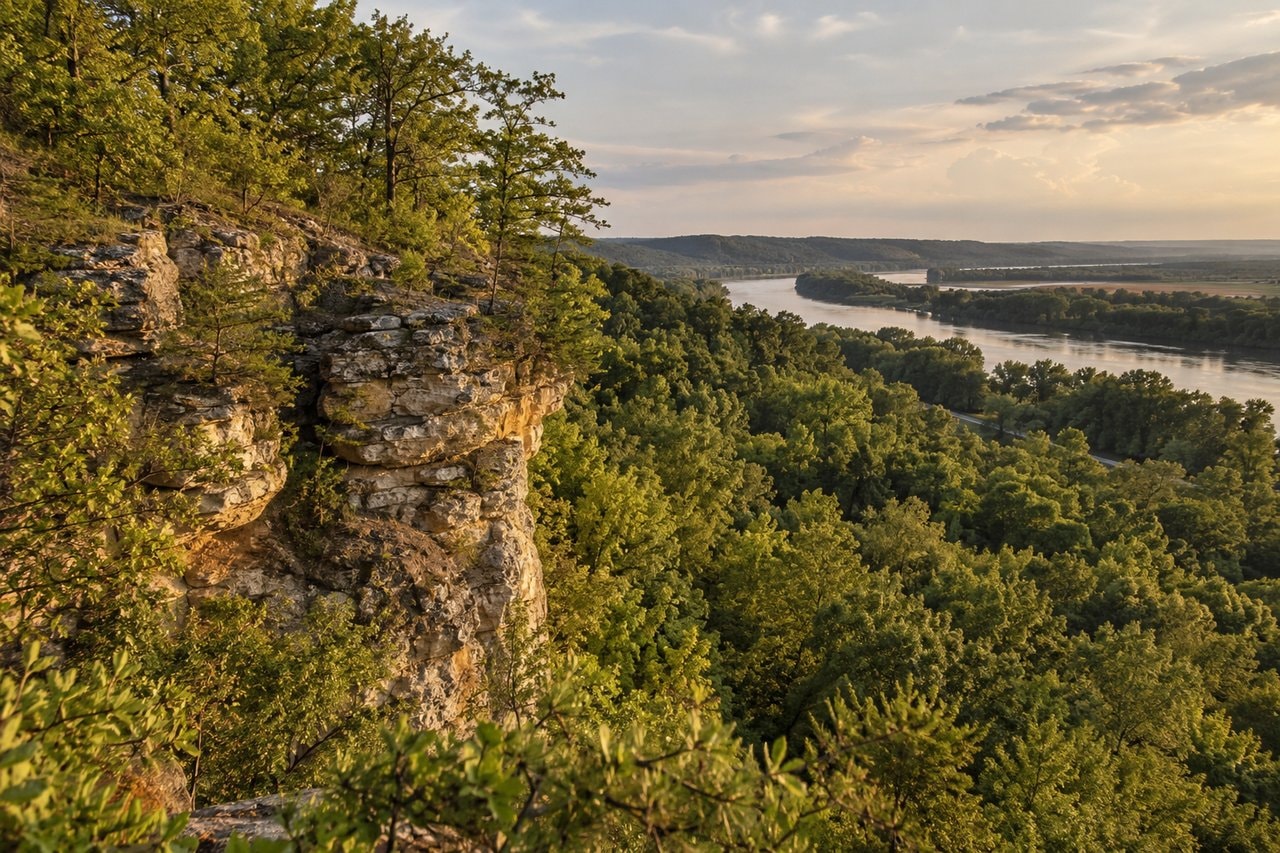
A nature almanac begins with attention: what is flowering, what is moving, what is changing overhead, and what the season asks of a garden or a walk. Here, the setting is southern Illinois and the neighboring corners of Missouri, Kentucky and Indiana. Woods and fields, bluffs and river bottoms belong in the same reading, even when their days do not unfold at the same pace. A small thing seen carefully can be as useful as a grand view.
Wikipedia’s account of southern Illinois places the region between the Mississippi and Ohio rivers and records the familiar name Little Egypt. Its Shawnee Hills reference describes hill country where resistant sandstone and limestone reach the surface, with much of the hills within Shawnee National Forest. Those are useful bearings for an almanac: river water below, rocky ground above, and many different places to pause between them.
The Cache River reference describes a wetland landscape with cypress and tupelo swamp. That setting broadens the picture beyond dry ridges and open fields. A regional reading can move from a creek hollow to standing water, then from a garden bed to the evening sky. The subjects belong together without needing to behave alike. A swamp salamander and a hill-country snake ask quite different questions of the observer.
The year, noticed rather than hurried
Natural events have a name as a field of study: phenology. The USA National Phenology Network explains it as the timing and recurring patterns of life, including leaves, migrating birds, flowers and ripening fruit. Temperature, rainfall and day length help shape those patterns. This is why a seasonal calendar works best as a way to look, rather than a promise that a flower or animal will appear on a particular morning.
Spring
Begin spring reading with the natural events calendar. Its entries connect seasonal observations with the plants and animals discussed in the longer features. A useful spring question is what has changed since the last visit to the same place. Record what is actually visible, including an uneventful visit. An expected event that has not appeared yet is still a reason to pay attention, rather than a reason to force the season into a neat box.
Summer
Summer invites a longer look at the growing world. The gardening year separates cold tolerance, growing conditions and pest identification, topics that are easy to confuse when a bed or lawn looks untidy. Read the practical garden pages beside the plant features. A garden can be considered both a place of work and a place of observation; not every leaf or burrow needs the same response.
Fall
Fall is a good season to distinguish an observation from a prediction. The weather-lore feature asks what familiar winter signs mean in tradition and what the references say about their reliability. A caterpillar, a seed or a colorful sky can be interesting on its own. Giving it a story does not automatically give it the power to forecast the months ahead.
Winter
Winter reading can turn upward to the sky through the year. Moon phases, solstices and meteor showers provide another rhythm beside the biological seasons. There is also room for slower reading about pottery, regional places, folklore and bread. An almanac need not end when a flower bed rests. It can change its pace along with the landscape and leave room for a question that needs more than a glance.
Choose a subject, then follow its neighbors
The sections below connect calendar reading with fuller accounts of wildlife, plants and fungi, gardens, the region’s places and history, and outdoor walking. Each feature leads toward related subjects rather than treating a species or a season as an isolated curiosity. The printed annual almanac of the same name was written by Jim Jung; About the almanac considers that publication and its late author as a separate subject.
The Almanac
- The natural events calendar: a year in the southern Illinois woods and waters
A month-by-month watch list grounded in stated seasonal timing, with local variation kept in view.
- The sky through the year: moon phases, equinoxes, solstices and meteor showers
Moon phases, seasonal solar markers and recurring meteor showers, explained without dated tables.
- Fishing by the moon? Solunar tables, the seasons and what studies find
The solunar idea, one catch-record study and the different seasonal lives of familiar freshwater fish.
- The gardening year in the southern Illinois hills
Cold tolerance, growing conditions, garden insects and why mole tunnels do not prove a grub problem.
- Planting by the signs: the almanac folklore of moon and zodiac
A description of fruitful and barren signs, the historical Man of Signs and the evidence boundary.
- Gardening by the moon: an old practice and what the evidence says
Moon-based gardening traditions set beside Extension accounts of the evidence and its limits.
- Weather lore: woolly bears, persimmon seeds and other winter signs
Woolly bears, seed shapes, shadow rituals and colored skies considered as lore rather than forecasts.
- Night lights, talking animals and lucky stones: folklore of the countryside
Talking-animal traditions, marsh-light stories and supposed stones, with an urgent animal-exposure caution.
Wildlife
- Why beavers build dams
Deep water is the object; the dam is the means. Follow the work from a chewed branch to a changing wetland.
- Brook salamanders of the southern Illinois hollows
Spots, stripes and barred tails belong to a small amphibian world at the meeting of rock, water and woods.
- Sirens: the eel-like salamanders of swamps and ditches
An eel-like body, feathery gills and tiny front limbs reveal an amphibian adapted to quiet, muddy water.
- The common snapping turtle
A broad head and long tail are only the visible part of a turtle whose daily life is mostly underwater.
- The three-toed box turtle and its neighbors
The hinged shell is familiar; the turtle’s woodland routes and seasonal needs are less easily seen.
- The timber rattlesnake and the region's other snakes
Wooded bluffs shelter snakes whose colors, seasons and habits reward a distant, careful look.
- Reptile eggs and hatchlings: what's in the nest
A patch of loose soil can hold a hidden stage of reptile life. The nest is best understood where it lies.
- The wild turkey: a social history
A bird with a long human history still follows its own year of flocks, displays, nesting and woodland food.
- Living with killdeer
Gravel, short grass and a shallow scrape can be a family home. A broken-wing display means the ground deserves space.
Cougar Watch
- Cougars return to the Midwest
Western wanderers, Illinois records and the difference between a visiting cat and a breeding population.
- Confirmed cougars in Illinois
What photographs, tracks and agency review can establish about a rare Illinois visitor.
- Cougar questions answered
Practical questions about mountain lions, with answers from wildlife agencies.
- Cougars and people: how rare attacks are and what agencies advise
The injury evidence, the limits of attack counts and attributed advice for an encounter.
- The blynx: when bobcats and lynx interbreed
Bobcat–Canada lynx hybrids, their parent species and the evidence behind reported cases.
Plants & Fungi
- Morels and other spring mushrooms
Spring mushrooms invite close attention, but a familiar outline never replaces certain expert identification.
- Frost flowers
Curled ice ribbons are a meeting of plant structure and weather, often gone when sunlight reaches them.
- Ghost flowers: Indian pipe, pinesap, beechdrops and dodder
Pale stems and thin twining vines show that plants can obtain their nourishment through very different connections.
- Gardening for butterflies and moths
Flowers for adults, leaves for caterpillars and room for moths after dark.
- Gourds: an ancient crop and the purple martin's house
A plant grown for its shell, and the swallow that makes use of a hollow gourd.
History & Places
- The Kirkpatrick pottery of Anna, Illinois
Stoneware, clay and the expressive pottery of Anna.
- Fountain Bluff: the hill in the Mississippi floodplain
An isolated sandstone hill, uncommon plants and rock art whose private sites are closed to the public.
- Ancient astronomy in the Mississippi valley
Cahokia's solar alignments and the careful interpretation of the region's rock art.
- The Mississippians: mound builders of the American Bottom
Maize, Cahokia, shared ceremonial imagery and the Indigenous builders of the earthworks.
More
- Sourdough: bread from wild yeast and lactic bacteria
The microbes behind a sour loaf, with a closing note on the region's persimmons.
- Walking the hills: what steep ground asks of knees, ankles and muscles
What studies and agencies say about steep ground, knees, ankles, muscles and outdoor hazards.
- Features by subject
All the longer features grouped by wildlife, plants, sky, gardens, places and outdoor questions.
- About the almanac
The almanac tradition, the printed regional annual and its late author, considered separately.
- Further reading
An annotated route to the agencies, field guides, references and studies behind the regional reading.