On this page
“There are mushrooms, and then there are Morels.” Jim Jung judged the excitement of a promising April woodlot to be an almost unassailable excuse for missing other engagements. In this part of the Midwest, the first cap of the spring is both a natural event and a piece of news that travels remarkably slowly whenever somebody asks exactly where it was found.
Learning to see the first one
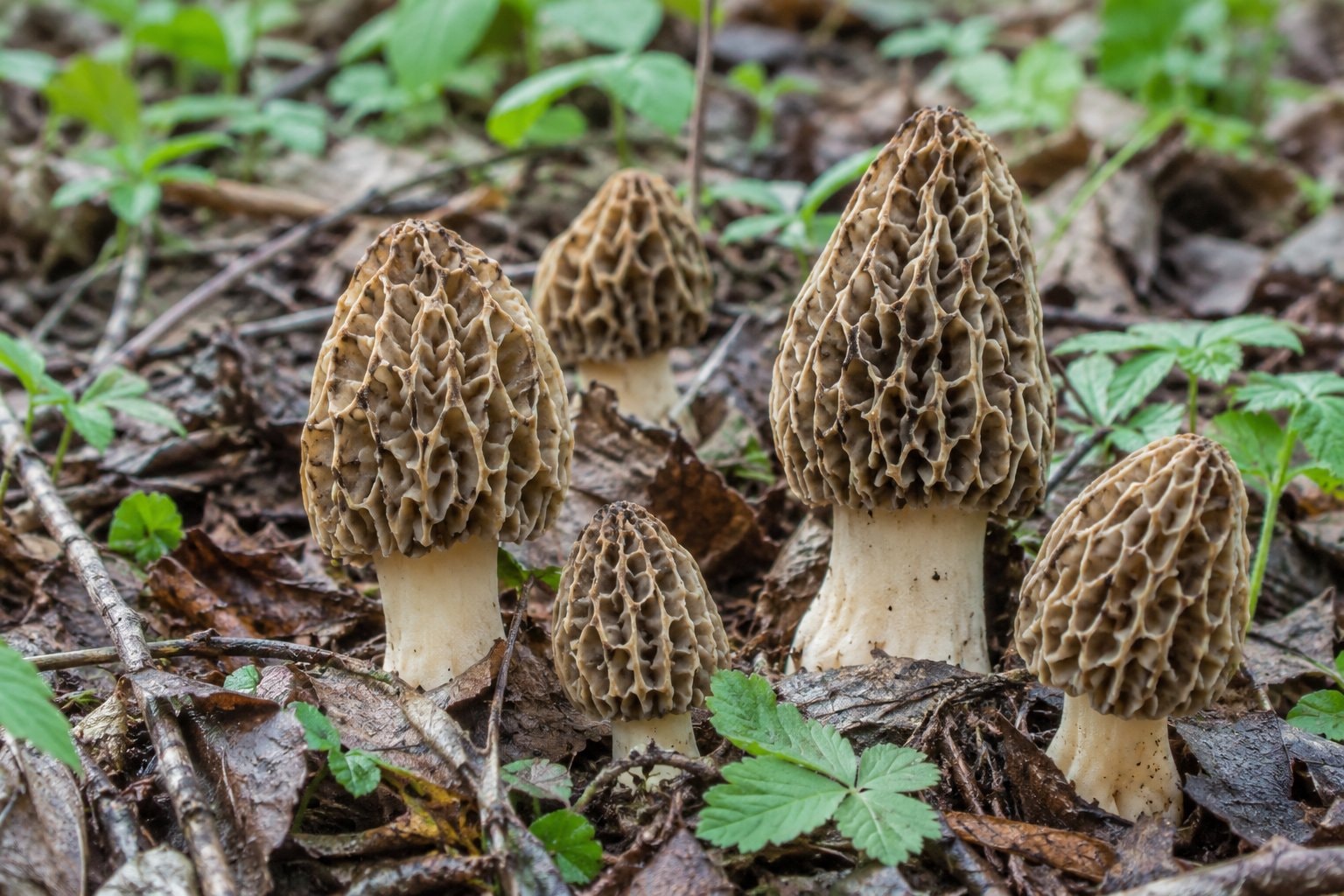
A morel in leaf litter has just about the same range of browns as the things around it. Walk slowly, let your eyes adjust and look back from a different angle. Once the folds of the first cap come into focus, the others in the same patch seem easier to see. Apple blossom made a convenient reminder in the Companion. A warm spell and rain in one hollow can bring on fruiting while another slope is still quiet.
Jim looked in early-succession woods with ash, elm and poplar and remembered old apple trees among the favorable surroundings. He described an early run of half-free and dark morels and the big pale ones he would find late in his local season. Species, trees and weather all affect the order. One glorious spring under an elm does very little to guarantee supper in the same place a year later.
The much larger part below ground
The pitted cap and hollow stem are a fruiting body. Below ground the fungus lives as fine branching threads called mycelium. Spores from the cap can begin another life cycle under suitable conditions. Looking at one mushroom gives little idea how far its fungus extends or how long it has been there. Morel species differ in their habits and relationships with trees.
Cultivating one of the familiar crops of edible fungi and coaxing a morel patch into fruit are quite different undertakings. A grower has to accommodate the fungus through stages that are invisible to somebody with a frying pan. Jim returned to this question in more than one annual, alongside his discussions of oysters, shiitakes and fairy rings. His recurring subject was the missing part under the soil.
The name and its lookalikes
| What a field description records | Why the detail matters |
|---|---|
| Cap surface | True morels have pits enclosed by ridges. Other spring fungi can have quite convincing folds, wrinkles or lobes at a distance. |
| Cap attachment | The cap meets the stalk low down in black and yellow morels. On a half-free morel part of the cap hangs away from the stalk. |
| Setting | Season, trees, soil and the habit of nearby specimens add information to a description. A single photograph leaves much of this out. |
A drawing or a photograph can help a visitor study the shapes. An experienced local identifier must examine a wild mushroom intended for eating. False morels can cause serious poisoning, and even correctly identified morels have caused illness. Thorough cooking matters and does not guarantee safety. Seek urgent professional or poison-center advice after suspected mushroom poisoning. Missouri field guide · Public health investigation of morel illness
The supper and the Moon
In Jim’s kitchen a familiar, positively identified morel got butter, pepper and a little savory. He liked them with eggs or in soup and had little patience with enough breading to hide the mushroom. Ruby’s hot-and-sour oyster mushroom soup was another point of comparison. That account is a record of a household taste. It cannot identify the next brown cap in the woods.
Moon lore made its way into the mushroom pages too. The almanac came across growers who associated a flush with the full moon and assigned mushrooms to watery Cancer. Soil moisture, temperature and repeated visits deserve their own entries beside the moon phase in a field notebook. The apple tree down the lane is at least convenient to check by daylight.