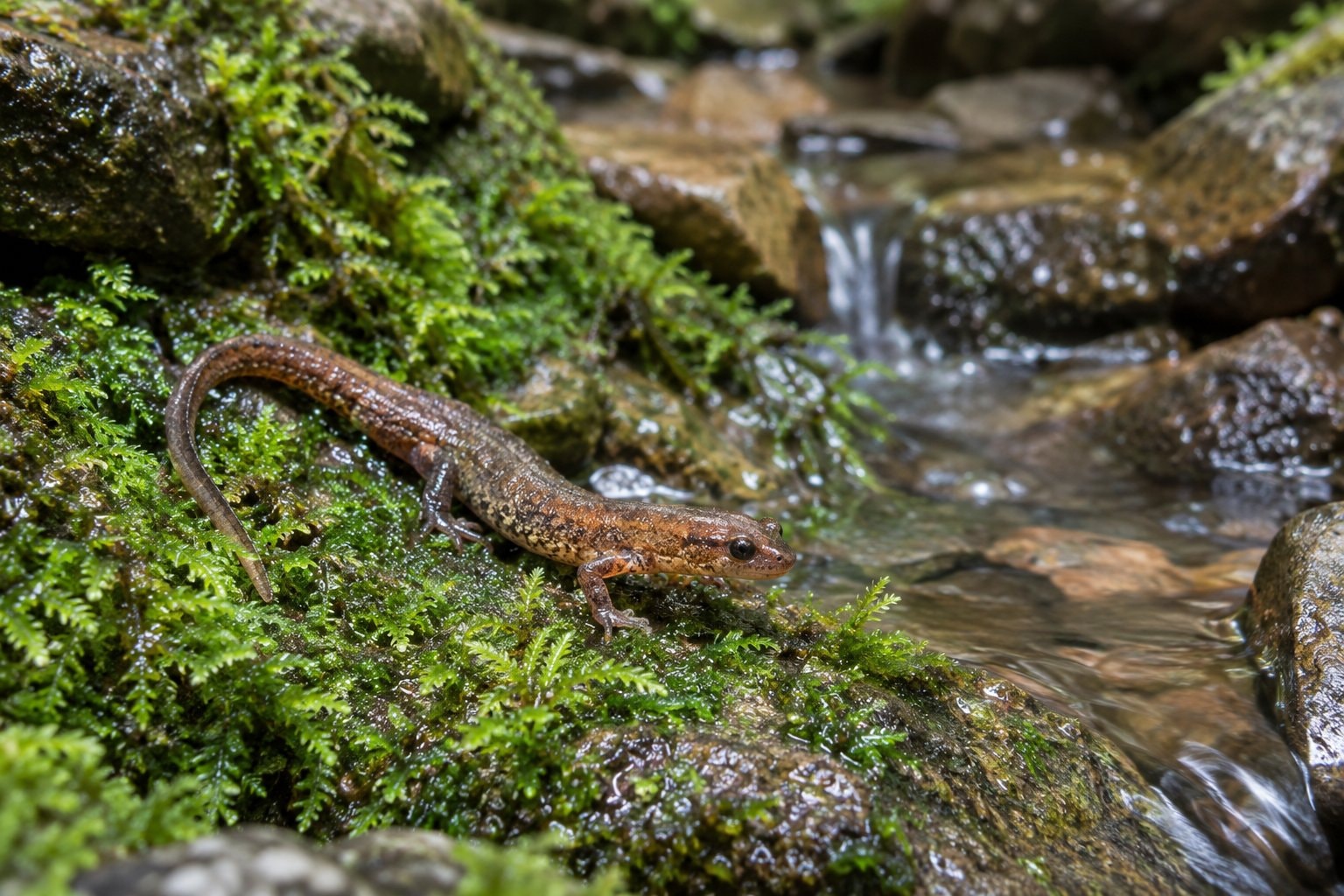
Brook salamanders belong to the North American genus Eurycea. The name points toward running water, but their lives include cave entrances, damp woodland, springs and seepages as well as stream channels. The cave salamander, long-tailed and dark-sided salamanders, and southern two-lined salamander make a useful group for learning to notice these small wet places. Their markings differ, yet their surroundings repeatedly bring rock, moisture and forest together.
A hollow can look empty while sheltering animals out of view. Salamanders spend much of their time beneath cover or in dim spaces. A chance sighting after rain is therefore a glimpse of an ongoing life, not evidence that the animals have suddenly arrived. Watch where one moves and how its body meets the wet surface; leave its cover and route intact.
Breathing through a moist surface
These brook salamanders belong to the lungless family, Plethodontidae. The Missouri Department of Conservation's cave salamander guide explains that adults obtain oxygen through the skin and the moist lining of the mouth. The absence of lungs is a defining part of their biology. Skin is a working respiratory surface, not merely a covering.
That fact gives damp habitat a meaning beyond comfort. A spring, a wet crevice and a shaded log supply conditions suited to an animal whose body surface exchanges gases with its surroundings. Underground water also matters to reproduction and summer shelter. The rocky hollow and its water are connected habitat, even where the stream disappears from sight.
The cave salamander is not a pale ghost
Eurycea lucifuga, the cave salamander, is usually orange with dark spots. Its yellow-orange underside is generally unspotted, and the tail tip is often dark. The name does not mean that the animal is blind or colorless. Cave-dwelling salamanders include very different kinds, and this spotted species should not be confused with every pale amphibian associated with underground water.
The Missouri field guide describes animals living in the dim zone beyond a cave entrance as well as farther inside. It also records them along rocky streams and springs, in woodland and spring-fed swamps, and on moist rocky ground in spring. Outside caves they are generally active at night, but heavy rain can bring them onto visible rocks during daylight.
Wet bodies help cave salamanders cling to walls, and their tails support them on cave formations. Those abilities belong to a life among uneven surfaces. Their food includes small arthropods such as pillbugs, seed shrimp and fly larvae. They in turn are food for larger animals. A cave is not an empty room with an unusual occupant; it is a delicate community.
Long tails and darker sides
The Missouri Department of Conservation's paired guide distinguishes the eastern long-tailed salamander from the dark-sided form. The eastern long-tailed animal is often yellow, with dark spots and conspicuous vertical bars along the tail. The dark-sided form has heavier pigment along its flanks, more back spotting and less regular tail markings.
These are helpful differences, not a promise that every animal will sort itself neatly. The guide notes intermediate markings where the forms overlap. Body color also varies. An uncertain identification can stay uncertain; a useful observation need not end with the closest possible name.
Both use wooded streams, springs, seepages and caves. They are mainly nocturnal, though a wet day following heavy rain can reveal them. Their young are aquatic and gilled before changing into the adult form, commonly in late summer. Winter courtship and egg laying make their year different from the simple spring-breeding schedule sometimes assumed for all amphibians.
A small animal with lengthwise stripes
Wikipedia's southern two-lined salamander account describes Eurycea cirrigera as a slender brown salamander with dark lines along the body extending onto the tail. Its adults use small rocky forest streams, seeps and springs. The lengthwise pattern contrasts with the spotted back of a cave salamander and the barred tail of an eastern long-tailed salamander.
Its eggs are associated with shallow flowing water and the undersides of submerged cover. That is reason enough to leave stones where they lie. Moving a rock to improve a view changes a shelter that may also hold eggs or young. A stream visit can concentrate on visible animals and the character of the habitat without opening every hiding place.
A record without a specimen
The Illinois Department of Natural Resources does not endorse collecting live specimens; its guidance also says collecting is prohibited in state parks and nature preserves. Look without collecting, handling or keeping salamanders. Record the visible pattern, whether the setting is a spring or stream, and whether the sighting followed rain. Keep cave wildlife undisturbed.
The region's sirens offer a striking contrast: permanent aquatic life and external gills in sluggish wetlands rather than the adult lungless pattern described here. Beaver ponds illustrate how wet habitats can change, while the natural events calendar sets observations beside the seasons. A salamander noticed in place keeps all of those relationships visible.